When tendon pain keeps coming back, rest and pain pills often feel like a temporary patch. That is usually when people start asking, how does shockwave therapy work, and why do so many providers use it for stubborn pain that has not improved with basic care.
Shockwave therapy is a non-surgical treatment that uses acoustic waves to stimulate healing in damaged or irritated tissue. It is commonly used for chronic tendon problems, plantar fasciitis, shoulder pain, calcifications, and other musculoskeletal conditions where the body has stalled in the healing process. The goal is not to numb the area for a few hours. The goal is to wake the tissue back up and help it repair.
How does shockwave therapy work in the body?
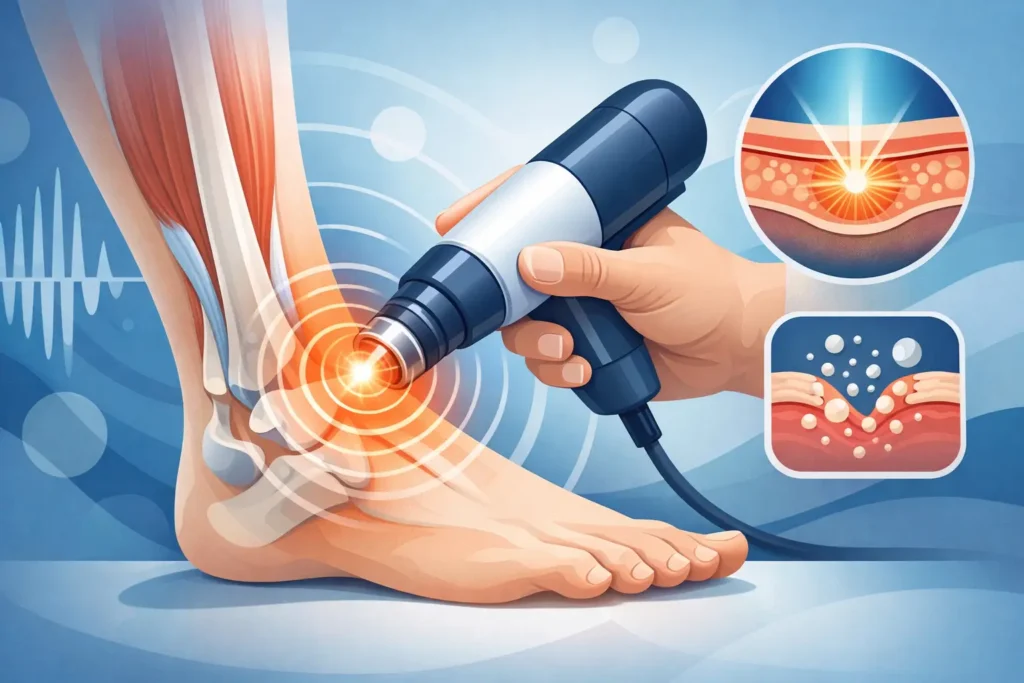
The short answer is that it delivers focused mechanical energy into injured tissue. Those sound waves create controlled microstress in the treatment area, which encourages a healing response. That response can include improved circulation, increased cellular activity, and changes in pain signaling.
In many chronic injuries, the tissue is not always torn in a dramatic way. More often, it is irritated, thickened, degenerative, or poorly healed after repeated strain. A tendon can stay painful for months because blood flow is limited and the normal repair cycle has slowed down. Shockwave therapy helps by stimulating the body to revisit that area and start a more active repair process.
Patients often hear phrases like tissue regeneration, collagen remodeling, and neovascularization. In plain language, that means the treatment may help the body build healthier support fibers, improve local blood supply, and break up the cycle of chronic irritation. It can also reduce pain by affecting nerve endings and lowering the sensitivity of the area over time.
This is why shockwave therapy is often different from treatments that only mask symptoms. It is designed to encourage recovery, not just short-term relief.
What shockwave therapy is actually treating
Shockwave therapy is most often used for soft tissue and tendon-related problems. These are conditions where the tissue is overloaded, inflamed, degenerative, or slow to heal. Common examples include plantar fasciitis, Achilles tendinopathy, tennis elbow, golfer’s elbow, patellar tendinopathy, calcific shoulder tendinitis, hip pain around the gluteal tendons, and certain chronic muscle trigger points.
It can also be helpful after injuries when pain lingers longer than expected. Some patients have already tried stretching, anti-inflammatory medication, braces, or physical therapy and still feel stuck. In those cases, shockwave therapy may be used as part of a broader plan to push recovery forward.
That said, it is not the right tool for everything. If pain is coming from a fracture, severe arthritis, a complete tendon tear, nerve compression from the spine, or a condition that needs surgery or urgent medical treatment, shockwave therapy may not be appropriate on its own. Good treatment starts with knowing what is actually causing the pain.
What happens during a treatment session?
A typical session is straightforward. The provider identifies the painful area, applies gel to help conduct the waves, and uses a handheld device to deliver pulses to the tissue. Depending on the condition, treatment may be focused on one spot or across a broader region where the tendon, fascia, or muscle is involved.
Most sessions are relatively short. Patients often describe the sensation as tapping, pulsing, or rapid pressure. Some areas feel only mildly uncomfortable, while others can be more tender, especially if the tissue is very irritated. The intensity can usually be adjusted based on your tolerance and the treatment goals.
You do not need anesthesia, and there is no incision or downtime in the surgical sense. Many people return to work or normal daily activity the same day. You may feel soreness afterward, much like the tissue has been worked on deeply. That is expected for some patients and usually settles within a day or two.
Why chronic pain sometimes responds better than fresh injuries
This is one of the most interesting parts of shockwave therapy. A new injury often already has an active healing response. The body knows something happened and sends blood flow, inflammatory chemicals, and repair cells to the area. With chronic pain, that process may have faded before the tissue fully recovered.
Shockwave therapy can be useful when the body needs a stronger signal to restart repair. Tendons in particular have limited blood supply, which is one reason they can become chronically painful. Repetitive strain from running, standing, lifting, sports, or manual labor can keep irritating the same spot without giving it a full chance to heal.
For patients who want to avoid relying on medication, this matters. Instead of chasing the pain day by day, the treatment aims to improve the condition of the tissue itself.
How long does it take to feel results?
Some people notice change after the first session, especially if pain sensitivity drops quickly. More often, improvement happens over several weeks as the body responds to treatment. That is because shockwave therapy is not simply covering up symptoms. It is trying to stimulate a biological process, and biology takes time.
Many treatment plans involve a series of sessions rather than a one-time visit. The exact number depends on the condition, how long it has been present, the location of the pain, and how the tissue responds. A person with mild plantar fasciitis that started recently may improve faster than someone with a year of calcific shoulder pain or a stubborn Achilles tendon problem.
Progress is also not always perfectly linear. Some patients feel sore before they feel better. Others notice better mobility first, then less pain. That does not mean the treatment is failing. It usually means the tissue is changing gradually rather than all at once.
How does shockwave therapy work with other treatments?
Shockwave therapy often works best as part of a larger recovery plan. If the underlying problem includes poor movement mechanics, muscle imbalance, repetitive overuse, or post-injury compensation, those issues still need attention. Otherwise, the tissue may keep getting overloaded.
That is why clinics that combine multiple approaches can be helpful. A patient may benefit from shockwave therapy alongside acupuncture, soft tissue work, guided exercise, activity modification, or other physician-directed care. In an integrative setting like Acupuncture & Injury, the focus is not on forcing one treatment philosophy. It is on using the right combination to reduce pain, improve function, and help people stay off long-term pain medication when possible.
There is a practical side to this. If your heel pain improves with shockwave therapy but your work boots, standing schedule, and calf tightness never change, the relief may not last as well as it should. The best outcomes usually come when treatment addresses both the painful tissue and the reason it stayed irritated.
Is shockwave therapy safe?
For the right patient, shockwave therapy is generally considered safe and well tolerated. Side effects are usually mild and temporary, such as soreness, redness, or bruising in the treated area. Serious complications are uncommon when the treatment is performed appropriately.
Still, proper screening matters. Some patients should avoid shockwave therapy or need medical clearance first, especially if they have certain bleeding disorders, are pregnant in specific treatment contexts, have active infection, have a tumor in the treatment area, or have other conditions where mechanical stimulation is not advised.
This is another reason evaluation matters more than hype. A treatment can be useful and still not be right for every person.
Who is a good candidate?
Good candidates are often people with tendon pain, fasciitis, overuse injuries, calcific conditions, or chronic soft tissue pain that has not improved enough with rest and basic conservative care. It can be especially appealing for adults who want a non-surgical option and are trying to reduce dependence on pain medication.
It may also fit people who need to stay functional. Working adults, active older adults, athletes, veterans, and patients recovering from auto injuries often want treatments that are practical, low downtime, and focused on getting them moving again.
The best candidate is not just someone with pain. It is someone whose diagnosis matches what shockwave therapy is designed to treat.
What patients should keep in mind before starting
Shockwave therapy is promising, but it is not magic. It does not fix every pain problem, and it should not be sold that way. Results depend on the diagnosis, the duration of symptoms, the quality of the treatment plan, and whether the area continues to be aggravated between visits.
Patients also do better when they understand the goal. This is not usually a passive comfort treatment. It is a therapy intended to create change in the tissue. Some discomfort during or after treatment can be part of that process.
If you have been living with heel pain, tendon pain, shoulder pain, or a nagging injury that keeps limiting your work, sleep, or exercise, the real question is not only how does shockwave therapy work. The better question is whether your pain has reached the point where your body needs more than rest, stretching, or another refill to finally move toward healing.
Leave a reply