A lot of people start looking for real help after the same pattern repeats itself for too long – pain flares up, medication dulls it for a few hours, then everything comes right back. If you are trying to get pain free without pills, you are not asking for anything unrealistic. You are asking for a treatment plan that addresses the source of the problem, not just the symptom.
That distinction matters. Pain medication can have a role in short-term care, especially after surgery or severe injury. But when pain becomes chronic, or when medications start creating their own problems, many patients need a different path. The goal is not to prove toughness or avoid medicine at all costs. The goal is to restore function, reduce suffering, and help your body recover with less dependence on daily pills.
What pain free without pills really means
Being pain free without pills does not always mean a single treatment fixes everything overnight. More often, it means using targeted therapies that lower inflammation, calm irritated nerves, improve circulation, and support tissue healing so pain begins to decrease for the right reasons.
For one patient, that may mean acupuncture for neck tension and headaches. For another, it may mean shockwave therapy for stubborn plantar fasciitis or tendon pain. Someone recovering from a car accident may need a broader plan that addresses muscle guarding, soft tissue damage, mobility loss, and the stress response that often follows trauma.
This is where expectations matter. Good pain care is not about chasing a numb feeling. It is about helping you move better, sleep better, work with less discomfort, and stop organizing your entire day around pain.
Why pills often stop being the right long-term answer
Pain medications can reduce symptoms, but they do not repair damaged tissue, improve joint mechanics, or retrain muscles that have been compensating for months. In some cases, they also create a cycle where the body becomes dependent while the original injury remains untreated.
That does not mean every medication is bad or every patient should stop medication immediately. It means long-term pain relief usually requires a broader strategy. If your back pain comes from muscle imbalance, inflammation, and limited mobility, a pill may quiet the pain signal while the underlying issue keeps getting worse. If you are dealing with opioid dependence on top of pain, the situation becomes even more serious and deserves physician-guided care, not judgment.
Patients often know this before they have the language for it. They say things like, “I can get through the day, but I am not getting better,” or “I do not want to keep taking something just to function.” That is usually the moment to look at restorative treatment instead of symptom management alone.
Treatments that can help you get pain free without pills
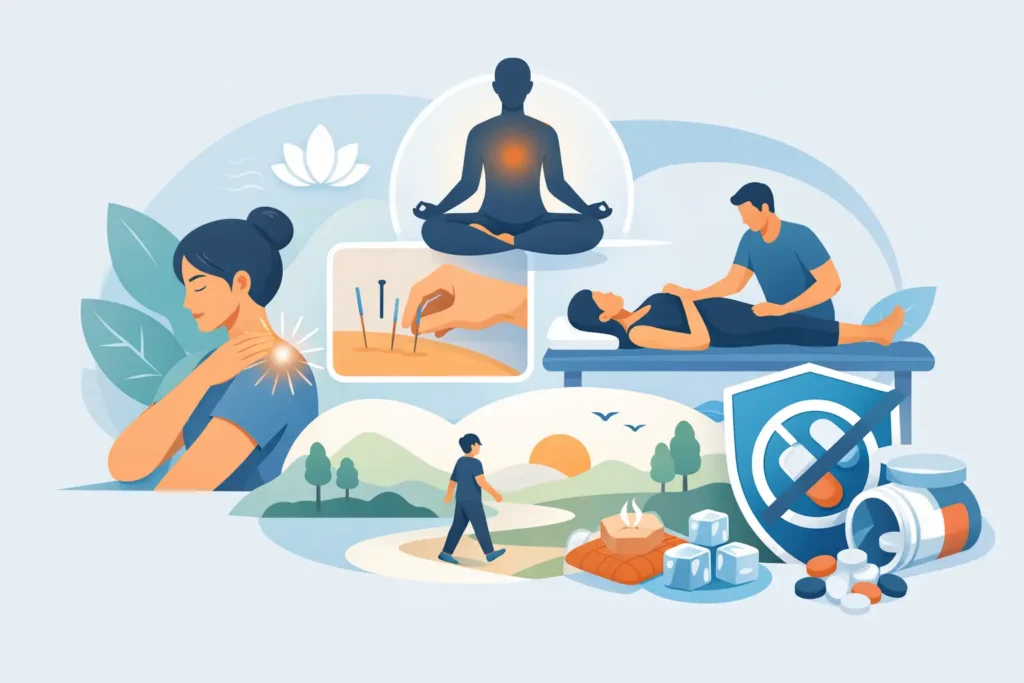
The most effective non-pill treatment plans usually combine more than one approach. That is because pain is rarely one-dimensional. It can involve inflammation, nerve sensitivity, restricted movement, poor circulation, stress, scar tissue, and delayed healing all at once.
Acupuncture for pain control and nervous system balance
Acupuncture is often one of the first options patients explore when they want drug-free pain relief. Done properly, it can help reduce muscle tension, improve blood flow, calm irritated areas, and regulate how the nervous system processes pain.
Many people are surprised by how practical it feels. They expect something vague or purely wellness-based, then realize it is being used to address very specific problems like sciatica, shoulder pain, migraines, low back pain, knee pain, and post-injury stiffness. It can also be helpful for patients whose pain is aggravated by stress, poor sleep, or prolonged inflammation.
The trade-off is that acupuncture is not usually a one-and-done treatment. Some people feel better quickly, while others improve over a series of visits. Consistency matters, especially with chronic conditions.
Shockwave therapy for stubborn injuries
When pain is tied to chronic tendon problems, scar tissue, or tissue that has simply stopped healing well, shockwave therapy can be a strong option. This treatment uses acoustic waves to stimulate circulation and tissue repair in areas that have become painful and slow to recover.
It is often used for plantar fasciitis, tennis elbow, shoulder tendinopathy, Achilles pain, and similar conditions that linger despite rest or basic treatment. For the right patient, it can help restart healing instead of just masking discomfort.
Not every painful condition needs shockwave therapy, and not every patient is the right candidate. But when an injury has become chronic and local tissue healing is part of the issue, it can be one of the more useful tools available.
Cupping and electroacupuncture for muscle pain and recovery
Some pain is driven by tight, overworked muscles and restricted soft tissue. Cupping can help reduce that built-up tension and improve local circulation. Electroacupuncture adds gentle electrical stimulation to acupuncture points, which can be especially helpful for stubborn muscle pain, nerve-related symptoms, or areas that have not responded fully to standard treatment.
These therapies are not about temporary pampering. In the right plan, they are used to change how painful tissue behaves so you can move with less resistance and recover more efficiently.
Injury care that follows the actual cause
A major reason patients stay stuck is that they receive generalized pain advice for a very specific injury. Rest, ice, and medication can help early on, but some injuries need a more directed recovery plan. Auto accident injuries are a good example. Whiplash, back strain, shoulder pain, and soft tissue trauma may not show their full effect on day one, yet they can become long-term problems if they are not treated early.
A medically supervised clinic can evaluate what is contributing to pain, monitor progress, and adjust treatment if symptoms change. That matters because healing is not always linear. Sometimes pain improves quickly while mobility lags behind. Sometimes inflammation settles down but nerve irritation remains. Good care accounts for that.
When pain and opioid dependence overlap
For some patients, the phrase pain free without pills carries a deeper urgency. They are not only trying to avoid medication side effects. They are trying to step out of dependence.
This requires compassion and medical structure at the same time. If someone has been using opioids for pain, or has developed opioid use disorder after injury treatment, the answer is not shame and it is not abrupt withdrawal without support. Physician-guided addiction treatment, including buprenorphine-based options when appropriate, can help stabilize cravings and withdrawal while the patient works on recovery.
That approach is not separate from pain care. In many cases, it is part of responsible pain care. A person cannot fully focus on healing from injury while also fighting withdrawal, fear, or the daily instability of unmanaged dependence. When both issues are treated together, outcomes are often better and safer.
What to expect from a good non-pill treatment plan
A credible treatment plan should feel personalized, not scripted. It should ask where the pain started, how long it has been present, what makes it worse, what you have already tried, and how the pain is affecting your daily life. It should also be honest about what is likely to improve quickly and what may take time.
If your pain is inflammatory and recent, relief may come faster. If it involves long-standing compensation patterns, old injuries, or nerve sensitivity, treatment may need more patience. That does not mean progress is not happening. It means your body may need both pain reduction and functional retraining.
This is one reason integrated care works well. A clinic like Acupuncture & Injury can combine physician oversight with therapies such as acupuncture, shockwave therapy, and injury treatment so patients are not forced into an all-or-nothing choice between conventional medicine and holistic care. For many people, that middle ground is exactly what makes recovery possible.
The better question to ask
Instead of asking, “What can I take for this pain?” it is often more useful to ask, “Why is this pain still here, and what will help it resolve?” That shift changes everything. It moves treatment from short-term suppression to actual recovery.
If you have been living from refill to refill, or if you are tired of being told to just wait it out, there may be a better option. Relief does not always come from doing more of what has not worked. Sometimes it starts when you choose care that helps your body heal, supports your nervous system, and gives you a real path forward without relying on pills every day.
Leave a reply