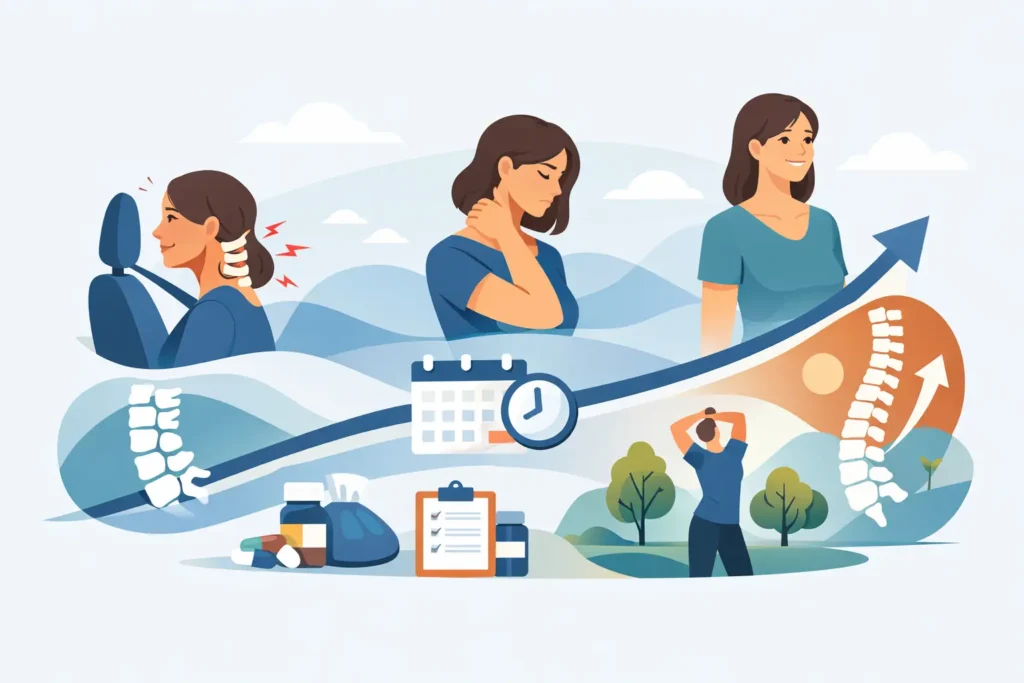
A rear-end crash can be over in seconds, but the soreness, stiffness, and headaches that follow can stay with you much longer. The whiplash recovery timeline is different for every patient, and that is exactly why early treatment matters. Some people improve in a few weeks. Others deal with pain, limited movement, and nerve irritation for months if the injury is not managed well from the start.
What is a typical whiplash recovery timeline?
Whiplash is a neck injury caused by a rapid back-and-forth motion of the head, most often after a car accident. That sudden movement can strain muscles, ligaments, joints, and surrounding soft tissue. In more severe cases, it can also irritate nerves and trigger pain into the shoulders, upper back, or arms.
A mild whiplash recovery timeline may be around two to four weeks. Moderate cases often take six to twelve weeks. More serious injuries, especially when treatment is delayed, can last several months or become chronic. Those broad ranges are helpful, but they do not tell the full story. Recovery depends on the force of the accident, your age, your overall health, whether you had prior neck issues, and how quickly you began appropriate care.
One of the biggest mistakes after an accident is assuming you are fine because nothing feels severe right away. Adrenaline can mask pain for hours or even days. It is common for whiplash symptoms to peak 24 to 72 hours after the injury.
The first 72 hours after whiplash
The earliest stage is often the most confusing. You may notice neck stiffness, pain when turning your head, headaches at the base of the skull, shoulder tightness, or fatigue. Some patients also feel dizziness, jaw discomfort, or tingling in the arms.
This is the point when a proper evaluation matters most. You want to rule out more serious injury, document the condition, and start a treatment plan before inflammation and muscle guarding become more entrenched. Rest can help in the short term, but complete inactivity for too long usually does not. Gentle movement, when medically appropriate, tends to support better outcomes than immobilizing the neck for extended periods.
Week 1 to Week 2: inflammation and guarding
During the first two weeks, inflammation is still active and the muscles around the neck often tighten to protect the injured area. That protective tightening can make pain feel worse, not better. Many patients describe a cycle of stiffness, headache, poor sleep, and increased soreness by the end of the day.
This is also when simple daily tasks can become surprisingly difficult. Driving, looking over your shoulder, sitting at a desk, or sleeping comfortably may all be affected. If treatment starts during this stage, the goal is usually to reduce inflammation, calm muscle spasm, improve circulation, and restore safe movement.
An integrative plan can be especially helpful here. Acupuncture may support pain relief and relaxation of tight tissue. Soft tissue care and guided mobility work can help prevent the neck from becoming more restricted. In some cases, shockwave therapy or other physician-guided options may be considered if there is persistent soft tissue involvement, though the best approach depends on the exact injury pattern.
Weeks 3 to 6: early healing, but not always full recovery
By the third week, many mild cases start to improve. Range of motion often increases first, followed by a gradual drop in pain intensity. Headaches may become less frequent, and patients may find they can work, drive, or sleep with less discomfort.
That said, improvement is not always linear. It is common to feel better for a few days and then flare up after a long workday, exercise, or too much screen time. This does not always mean something is wrong. Soft tissue healing can be uneven, and the nervous system may still be reactive.
If symptoms are not clearly improving by this point, the whiplash recovery timeline may be moving into a more stubborn phase. Ongoing pain, radiating symptoms, numbness, severe headaches, or significant limitation in motion should not be brushed off as normal soreness.
Six weeks to three months: where some cases become chronic
Patients who still have noticeable symptoms after six weeks need closer attention. At this stage, untreated whiplash can shift from an acute injury into a longer-term pain problem. The issue is not always severe tissue damage. Sometimes the bigger problem is persistent inflammation, altered movement patterns, scar tissue, muscle imbalance, or nervous system sensitization.
This is where comprehensive care can make a real difference. A treatment plan should not just chase pain day by day. It should address why the pain is lingering. That may include improving joint mobility, reducing muscle tension, restoring function, and helping the body move normally again.
For patients trying to stay Pain Free Without Pills, this matters. Relying only on pain medication may dull symptoms temporarily, but it does not correct the underlying mechanics of recovery. A medically supervised clinic that combines natural and physician-guided treatments can often provide a more practical path forward, especially after an auto injury.
What affects the whiplash recovery timeline?
A few factors tend to influence healing more than others. The severity of the crash matters, but so does what happened afterward. A relatively modest collision can still create prolonged symptoms if the neck was already vulnerable or if treatment was delayed.
Age can slow tissue healing, and preexisting issues such as arthritis, prior concussion, disc problems, or chronic neck tension can complicate recovery. Stress and poor sleep also matter more than many people realize. When the body stays tense and sleep quality drops, pain tends to linger longer.
Work demands can also change the timeline. Someone with a desk job may struggle with long periods of sitting and screen use, while someone in construction, warehouse work, or nursing may aggravate the injury through lifting and repetitive movement. Recovery has to match real life, not just textbook expectations.
Signs you may need more than time and rest
Mild soreness can improve on its own, but some symptoms deserve prompt follow-up. Pain shooting into the arm, hand weakness, persistent numbness, severe dizziness, worsening headaches, jaw pain, or trouble concentrating may suggest a more complex injury. If symptoms are interfering with work, sleep, or driving, that is also a sign you may need active treatment rather than waiting it out.
The same is true if your pain keeps returning after temporary improvement. Recurrent flare-ups often mean the neck has not regained proper stability and function yet.
How treatment can support a faster, safer recovery
The best treatment plan depends on the patient, but in general, recovery improves when care focuses on both symptom relief and tissue healing. Acupuncture can help reduce pain, calm muscle tension, and support circulation. For many patients, it is a useful option when they want relief without increasing dependence on medication.
Manual therapies, corrective exercises, and activity guidance can help restore normal movement. Medically supervised injury care is important when symptoms are more complex, when imaging or referral is needed, or when pain is not responding as expected. The advantage of an integrative clinic is that you are not forced into a single approach. You can receive care that is conservative, practical, and adjusted as your recovery changes.
At Acupuncture & Injury, that type of model is built around helping patients reduce pain, improve function, and avoid getting stuck in a cycle of pills and prolonged discomfort.
When should you expect to feel normal again?
That depends on what “normal” means for you. Some patients are mostly pain-free within a few weeks but still feel tight with long drives or stressful days. Others can return to work before they are fully healed, which can make recovery feel slower. A realistic goal is steady progress in pain, motion, sleep, and daily function.
If you are seeing small but consistent gains, that is encouraging. If you are stalled, backtracking, or developing new symptoms, it is time to reassess. The sooner the treatment matches the real problem, the better your chances of avoiding long-term pain.
Whiplash can look minor from the outside while causing major disruption to daily life. Give your neck the attention it deserves early, and you give your body a better chance to heal fully instead of simply learning to live around the pain.
Leave a reply