A back spasm can stop your day in seconds. One wrong turn getting out of the car, one awkward lift at work, or one night of poor sleep can leave your lower or upper back tight, locked up, and painful to move. If you are looking into how acupuncture helps back spasms, you are probably not interested in vague wellness talk. You want to know whether it can reduce pain, relax the muscle, and help you get moving again without relying only on medication.
For many patients, the answer is yes – but the reason it helps is more specific than simply saying it “relaxes the body.” Back spasms usually happen when muscles tighten in response to irritation, strain, inflammation, joint dysfunction, or nerve aggravation. Acupuncture works by addressing several parts of that cycle at once.
How acupuncture helps back spasms in the body
A muscle spasm is often the body trying to protect an injured or irritated area. The problem is that the protective response can become part of the pain itself. Tight muscles reduce movement, restricted movement increases irritation, and more irritation leads to more guarding.
Acupuncture can help interrupt that loop. When very fine needles are placed in targeted areas, they stimulate the nervous system and local tissues in ways that may reduce pain signaling, improve circulation, and ease abnormal muscle tension. In plain terms, treatment may help the muscle stop clenching so hard while also calming the irritated structures that triggered the spasm.
This matters because a back spasm is not always just a muscle problem. In some people, the spasm starts after a lifting injury. In others, it is tied to a disc issue, poor posture, repetitive strain, an auto accident, or chronic inflammation around the spine. That is one reason a careful evaluation matters. The best treatment plan depends on what is keeping the area irritated.
Why spasms happen and why they keep coming back
Some spasms are short-lived. You tweak your back, the area tightens, and over a few days it settles down. Other cases are more stubborn. The muscle may loosen briefly, then tighten again as soon as you return to work, sit too long, or bend a certain way.
That pattern usually means the muscle is reacting to an underlying stress it does not trust. It could be joint restriction, uneven muscle loading, nerve irritation, or lingering inflammation after an injury. If all you do is mask the pain for a few hours, the body often returns to the same protective response.
This is where acupuncture is useful as part of a broader pain management and recovery approach. It is not just aimed at the symptom on the surface. It can support tissue healing, reduce inflammatory signaling, and help restore more normal movement patterns. For some patients, that means fewer spasms over time, not just temporary relief.
What treatment is trying to change
When someone comes in with back spasms, the goal is not only to make the area feel better on the table. The goal is to reduce the conditions that keep triggering the spasm.
Acupuncture may help by increasing local blood flow to tight or irritated tissue. Better circulation can support healing and help clear out inflammatory byproducts that contribute to pain. Needling can also influence how the brain and spinal cord process pain, which may lower the sense of threat around the injured area.
There is also a muscular effect. Tight bands of tissue and trigger points can become less reactive after treatment. That can make the back feel less rigid and improve range of motion. When movement improves, patients often find it easier to walk, stand upright, sleep, or return to normal activities without setting off the same pain cycle.
How acupuncture helps back spasms compared with pain medication alone
Medication can have a role, especially when pain is intense. But many people with spasms are looking for relief that does not depend on taking more pills just to get through the day. Muscle relaxers and pain medicine may dull symptoms, but they do not necessarily improve how the tissue is functioning.
Acupuncture is often appealing because it approaches the problem differently. Instead of only suppressing pain perception, it may help reduce the muscle guarding, calm irritated nerves, and support healing in the affected area. For patients trying to avoid long-term reliance on medication, that can be a meaningful difference.
That does not mean acupuncture replaces every other treatment. Sometimes the best approach is combined care. A patient may need physician-guided pain management, injury treatment, physical support, or other therapies depending on the cause of the spasm. Good care is not about forcing an all-or-nothing choice between natural treatment and medical treatment. It is about using the right tools together.
What a session may feel like
People new to acupuncture often worry that it will be painful, especially when their back is already in spasm. Most are surprised by how gentle treatment feels. The needles are much thinner than the ones used for injections. You may feel a quick pinch, pressure, warmth, tingling, or a dull ache, but many points are barely noticeable.
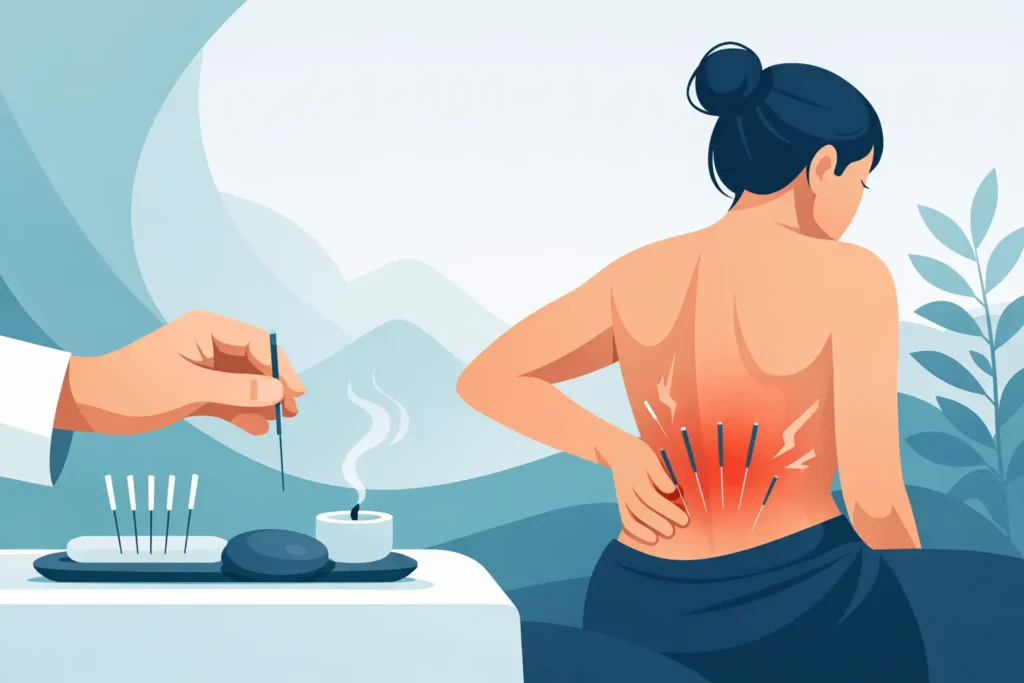
During treatment, the practitioner may place needles near the painful area, along related muscle groups, or at points that help regulate pain and muscle tension more broadly. In some cases, electroacupuncture is used. This applies a mild electrical stimulation through the needles to encourage a stronger muscle-relaxing and pain-modulating effect. For certain patients, that can be especially helpful when spasms are severe or recurring.
Some people feel relief after one visit. Others need a short series of treatments before the back starts calming down in a more lasting way. It depends on how long the spasm has been present, what caused it, and whether there are deeper mechanical or inflammatory issues involved.
When acupuncture may work best
Acupuncture can be helpful for acute back spasms after overuse, sudden strain, sports activity, repetitive work, or minor injury. It can also support recovery when spasms are part of a chronic pain picture, such as recurring low back pain, tension from postural strain, or lingering tightness after an accident.
It tends to work best when the spasm is part of a treatable musculoskeletal issue and the patient follows through with the full plan. That may include rest in the early stage, hydration, movement guidance, posture changes, or complementary therapies based on the case.
There are also times when back spasms need urgent medical attention. If pain is paired with fever, major weakness, loss of bowel or bladder control, numbness in the groin area, or a serious fall or crash, that should be evaluated right away. Acupuncture can be valuable, but it is not the first step for every back pain emergency.
A practical reason patients choose it
One of the biggest frustrations with back spasms is how disruptive they are. You cannot focus at work, sleep comfortably, exercise normally, or even sit through a commute without feeling the back tighten up again. Patients are not just looking for a diagnosis. They want a treatment that helps them function.
That is one reason clinics such as Acupuncture & Injury see interest from people who want pain relief without moving straight to stronger medication or invasive procedures. A treatment plan that combines acupuncture with medically supervised care, injury-focused evaluation, and other non-surgical options can make sense for patients who want both relief and a clear recovery strategy.
What results are realistic
Acupuncture is not magic, and it does not fix every cause of back pain in one session. If a patient continues the same heavy strain, has an untreated disc issue, or is dealing with significant structural problems, spasms may return unless the underlying cause is addressed.
Still, realistic benefits can be meaningful. Many patients report reduced pain intensity, less tightness, better flexibility, easier sleep, and improved day-to-day movement. Some notice they recover faster from flare-ups. Others find they need less medication to stay comfortable.
The biggest advantage may be that treatment supports the body while it heals rather than simply covering symptoms. For people who are tired of cycling through pain, pills, and temporary relief, that shift matters.
If your back keeps tightening without warning, do not assume you just have to live with it. A spasm is often your body asking for a better plan, and the right treatment can help it settle down, heal, and trust movement again.
Leave a reply