A sore neck the morning after a car accident is easy to dismiss. Then the stiffness sets in, turning your head becomes difficult, headaches start, and suddenly basic tasks like driving, working at a desk, or sleeping feel harder than they should. When patients ask about the best treatments for whiplash recovery, the right answer usually is not one single therapy. It is a plan that calms pain, protects healing tissue, and restores normal movement before the problem turns chronic.
What whiplash actually does to the body
Whiplash is a soft tissue injury that happens when the head is forced backward and forward quickly, most often in a rear-end collision. That rapid motion can strain muscles, ligaments, tendons, joints, and nerves in the neck and upper back. Some people feel symptoms right away. Others do not feel the full effect until hours or even a couple of days later.
Pain is only part of the picture. Whiplash can also cause reduced range of motion, shoulder tension, headaches, dizziness, jaw tightness, tingling, fatigue, and trouble concentrating. The reason recovery can be frustrating is that the injury is real even when standard imaging does not show a fracture or major structural damage.
That is one reason early treatment matters. Waiting too long can lead to guarding, poor posture, muscle imbalance, and a cycle where pain causes stiffness and stiffness causes more pain.
Best treatments for whiplash recovery usually work together
The most effective care for whiplash tends to be integrative. In plain terms, that means combining medical evaluation with hands-on and non-drug therapies that target pain, inflammation, and mobility. Treatment should match the severity of the injury, your symptoms, and how long it has been since the accident.
A proper evaluation comes first
Before starting treatment, it is important to rule out serious injury. If there is severe pain, weakness, numbness, loss of coordination, or concern for fracture or concussion, medical assessment should happen first. A good whiplash plan starts with knowing what you are treating.
Once serious complications are ruled out, conservative care is often the next step. This is where many patients do well, especially when treatment starts early and stays consistent.
Early injury care can reduce longer-term problems
In the first stage, the goal is to reduce irritation without letting the neck become inactive for too long. Complete bed rest usually slows recovery. Gentle movement, guided activity modification, and targeted pain relief tend to work better than doing nothing and hoping it passes.
Short-term rest may help during the first day or two if movement is very painful, but prolonged immobilization can make stiffness worse. Soft collars, for example, may feel supportive for some patients early on, yet overuse can delay the return of normal neck function. This is where clinical guidance matters.
Acupuncture for whiplash pain and muscle tension
Acupuncture is one of the most useful options for patients who want pain relief without relying heavily on medication. For whiplash, it is often used to calm muscle spasm, reduce pain signals, improve circulation, and help restore more comfortable movement in the neck, shoulders, and upper back.
Many patients with whiplash are not just dealing with one sore spot. They have a pattern of tension that extends into the traps, shoulder blades, jaw, and sometimes the low back because the body compensates after the accident. Acupuncture can address that broader pattern while still focusing on the most painful areas.
Some patients feel relief quickly, especially when treatment begins soon after injury. Others need a series of visits because the body has been protecting the area for weeks. That does not mean the treatment is failing. It often means the injury has moved from acute irritation into a more stubborn pain pattern.
Electroacupuncture may help when symptoms linger
When standard acupuncture is helpful but not enough, electroacupuncture may be added. This uses a gentle electrical current through the needles to stimulate the tissue more directly. It can be especially useful for tight muscles, referred pain, and persistent trigger points after a collision.
For patients trying to avoid stronger pain medication, this can be an important part of care. The goal is not to mask symptoms. It is to help the tissue settle down so movement and rehab become easier.
Physical rehabilitation and guided movement
One of the best treatments for whiplash recovery is restoring movement in a controlled way. When the neck stops moving normally, surrounding muscles often become overworked and protective. That can keep pain going even after the initial strain starts healing.
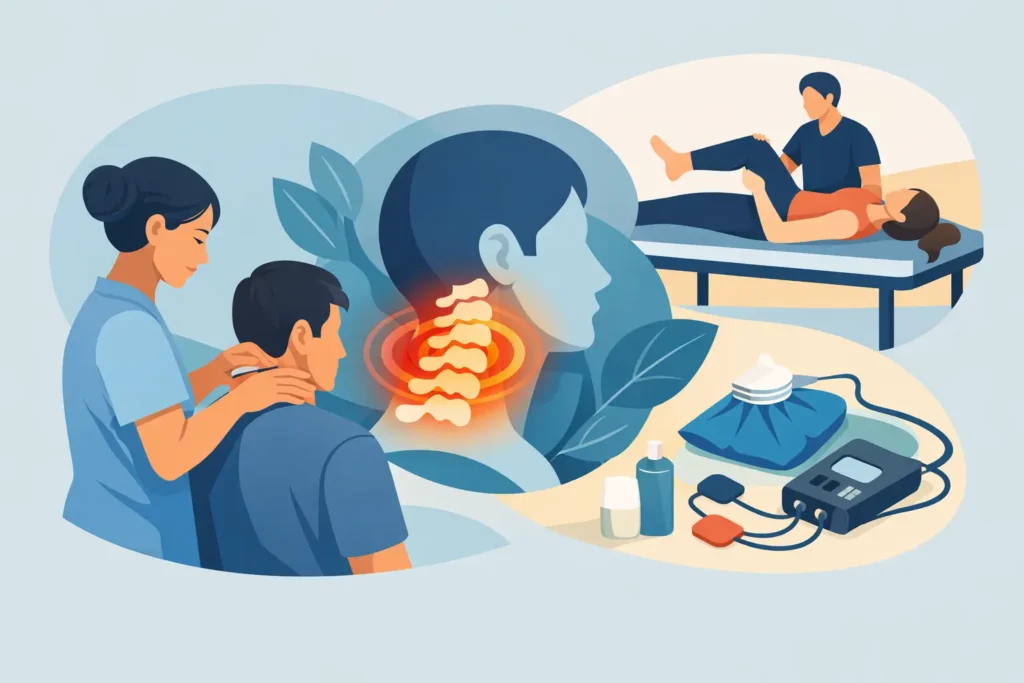
Rehab may include range-of-motion exercises, posture correction, muscle activation, stretching, and gradual strengthening. The right exercises depend on the patient. Someone with acute pain after a recent accident may need a very gentle program. Someone with symptoms that have lasted for months may need more focused work on stability and posture.
This is where generic online exercise videos can miss the mark. Some movements help one patient and aggravate another. Progression matters. Pushing too hard too soon can flare symptoms, but avoiding movement entirely can prolong recovery.
Shockwave therapy for stubborn soft tissue pain
For patients whose whiplash symptoms are not resolving as expected, shockwave therapy may be worth considering. This treatment uses acoustic waves to stimulate healing in injured soft tissue, improve blood flow, and reduce pain in areas that have stayed tight and irritated.
It is not the first answer for every case of whiplash, but it can be valuable when there is persistent muscle tension, myofascial pain, or tissue that seems stuck in an unhealthy healing pattern. In an integrative setting, shockwave therapy may be paired with acupuncture and rehab rather than used on its own.
That combination often makes sense. One treatment may calm pain, another may stimulate healing, and another may retrain movement. When those pieces support each other, recovery tends to move forward more efficiently.
Manual therapy, soft tissue work, and cupping
Hands-on care can also play a role in reducing muscle guarding and improving motion. Soft tissue treatment may help release tight bands in the neck and upper back, while joint-focused manual techniques can sometimes improve restricted movement when used appropriately.
Cupping can be helpful for certain patients with significant myofascial tightness or upper back tension after an accident. It is not a cure for whiplash by itself, but it may reduce tissue restriction and make other therapies more comfortable.
As with any technique, timing matters. Aggressive treatment too early can aggravate an already irritated area. The best approach is usually measured and responsive to how the patient is presenting that day.
Medication has a place, but it should not be the whole plan
Some patients need short-term medication support, especially in the early phase when pain is interfering with sleep or daily function. Anti-inflammatory medication or muscle relaxers may be appropriate in some cases under medical supervision.
The concern is when medication becomes the only strategy. Pain relief without restoring motion and function often leads to short-term comfort but incomplete recovery. For patients who want to stay as pain free as possible without pills, non-drug therapies become even more important.
A medically supervised clinic can help patients balance symptom relief with a treatment plan that actually moves healing forward.
What helps recovery go faster
The best treatments for whiplash recovery are only part of the equation. Outcomes also improve when patients avoid a few common mistakes. One is waiting too long to get checked because the pain seemed minor at first. Another is stopping care as soon as the pain drops slightly, even though stiffness and weakness remain.
Recovery tends to go better when treatment starts early, symptoms are monitored, and progress is reassessed regularly. If headaches are worsening, numbness develops, or dizziness continues, the treatment plan may need to change. Good care is not static.
It also helps to set realistic expectations. Mild cases may improve within a few weeks. Moderate or more complicated cases can take longer, especially if the injury involved multiple areas or the patient had prior neck problems. Faster is ideal, but stable healing matters more than rushing back into full activity too soon.
When to seek care after an accident
If neck pain, headaches, stiffness, or shoulder tension begin after a car accident, it is smart to get evaluated even if the crash seemed minor. Low-speed collisions can still produce significant whiplash symptoms. Early care may reduce the risk of chronic pain and help document the injury clearly from the beginning.
In a clinic such as Acupuncture & Injury, treatment can be built around both immediate relief and longer-term recovery. That means looking beyond pain scores alone and focusing on how well you can turn your head, sleep, work, drive, and return to normal life.
Whiplash recovery is rarely about finding one magic treatment. It is about getting the right combination at the right time, with enough follow-through to help your body stop protecting the injury and start healing from it.
Leave a reply