Reaching for a seatbelt, lifting a grocery bag, or trying to sleep on one side can become a daily reminder that your shoulder is not right. When that pain keeps hanging on, many patients start looking for something beyond rest, anti-inflammatory medication, or another steroid shot. That is where shockwave therapy for rotator cuff problems often enters the conversation.
For the right patient, it can be a practical, non-surgical option that helps calm pain and stimulate healing in tissue that has been irritated, overloaded, or slow to recover. It is not magic, and it is not the best answer for every type of shoulder injury. But when used thoughtfully as part of a treatment plan, it can make a real difference in pain, motion, and function.
What shockwave therapy does for the rotator cuff
The rotator cuff is a group of four muscles and their tendons that help stabilize and move the shoulder. Because the shoulder has such a wide range of motion, these tendons do a lot of work and take on a lot of strain. Over time, that can lead to tendinitis, tendinopathy, small tears, impingement, calcification, or stubborn inflammation that never fully settles down.
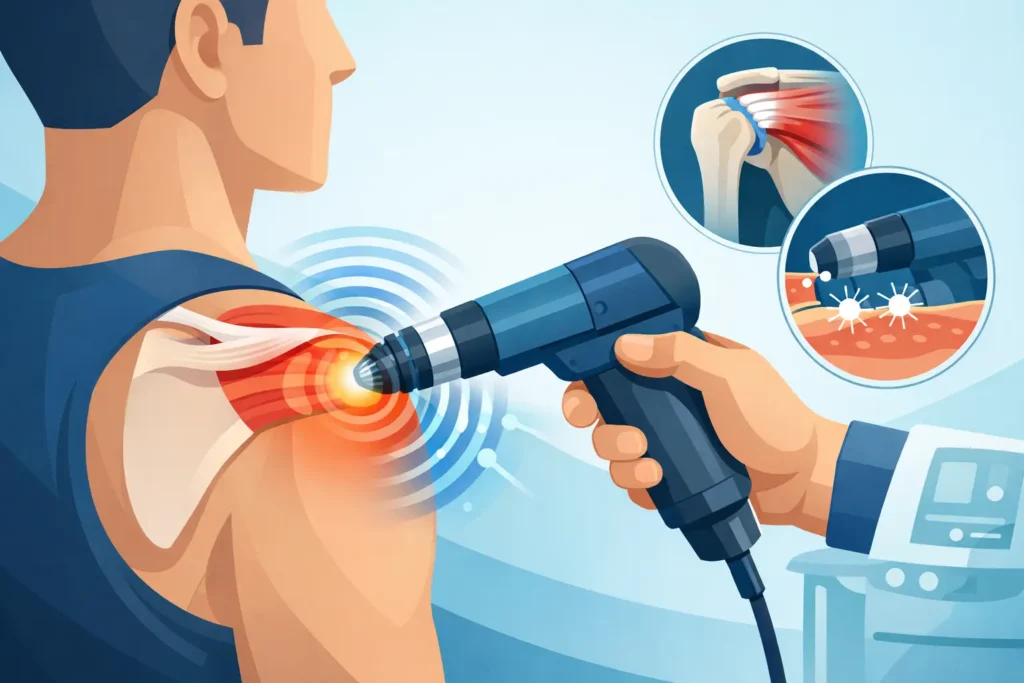
Shockwave therapy uses acoustic waves delivered to the injured area through the skin. The goal is not to numb the problem. The goal is to stimulate a healing response. In many cases, that means improving local blood flow, encouraging tissue repair, reducing pain signaling, and helping the body address chronic irritation that has been lingering for weeks or months.
This matters because many rotator cuff issues are not just about inflammation. Chronic tendon pain often involves degenerative changes in the tissue, reduced healing activity, and mechanical stress that keeps the area from recovering well on its own. Shockwave therapy is often considered when a patient wants to avoid surgery, reduce reliance on pain medication, and move toward more active healing.
When shockwave therapy for rotator cuff pain may help most
This treatment tends to be most helpful in a few common situations. One is chronic rotator cuff tendinopathy, especially when shoulder pain has lasted for several weeks or longer and standard conservative care has not done enough. Another is calcific tendinitis, where calcium deposits form in the tendon and create significant pain and restricted motion. Shockwave therapy has been studied quite a bit in those cases and is often used to help break up calcific deposits and improve symptoms.
It may also help with impingement-related pain, mild to moderate overuse injuries, and recovery plateaus where the shoulder is no longer in an acute crisis but still not functioning the way it should. Some patients say the biggest improvement is not just lower pain. It is being able to lift the arm more comfortably, sleep better, and get back to work or exercise without guarding every movement.
That said, it depends on the diagnosis. A full-thickness rotator cuff tear, major instability, fracture, or severe structural damage may require a different path. If someone has dramatic weakness, cannot raise the arm, or suffered a traumatic injury, proper evaluation comes first.
What treatment feels like
Most patients are surprised by how straightforward the process is. A clinician identifies the painful or damaged area and applies the treatment head over the skin. The device sends a series of acoustic pulses into the tissue. Sessions are usually brief, and because there is no incision or injection, there is little downtime.
You may feel tapping, pulsing, or a deep ache during treatment. Some areas are more sensitive than others, especially if the tendon is inflamed or calcified. The discomfort is usually tolerable, and intensity can often be adjusted. Afterward, the shoulder may feel sore for a day or two, similar to what you might feel after deep tissue work or a tough workout.
Results are not always immediate. Some patients notice early pain relief, but many improve gradually over a series of sessions as the tissue response builds. That slower pattern can be frustrating if you want instant relief, but it is also part of what makes the treatment different from approaches that simply mask symptoms.
Why it is often paired with other care
Shoulders rarely get better from one intervention alone. If the tendon is overloaded by poor mechanics, muscle imbalance, repetitive work, or compensation patterns, the pain can keep coming back unless those factors are addressed too.
That is why shockwave therapy often works best as part of an integrative plan. Depending on the patient, that may include activity modification, targeted rehabilitation, acupuncture, soft tissue treatment, mobility work, or physician-guided pain management that reduces dependence on pills. At Acupuncture & Injury, that blend of natural treatment and medical oversight is often what patients want most – real options without feeling pushed into surgery or long-term medication too quickly.
For example, if someone has shoulder pain from a job that involves overhead lifting, the immediate goal might be reducing tendon irritation and restoring motion. But the longer-term goal is helping the shoulder tolerate work demands again. That usually requires both symptom relief and better function.
Benefits patients care about most
The biggest reason people ask about this treatment is simple: they want pain relief that does not rely on medication. That is especially true for patients who have already spent too much time cycling through anti-inflammatories, muscle relaxers, or repeated injections.
Shockwave therapy may help reduce pain, improve range of motion, and support tissue healing without surgery. It is non-invasive, fast, and generally does not require time away from normal daily activities. For some patients, it can also help them re-engage with rehab because the shoulder is no longer flaring up with every movement.
There are trade-offs, though. Not everyone responds the same way. Some shoulder problems improve significantly, while others improve only modestly. A patient with calcific tendinitis may have a different response than someone with advanced tendon degeneration or a significant tear. Expectations matter. This is a treatment with a purpose, not a guaranteed quick fix.
Who should be cautious
A proper exam matters because shoulder pain is not always coming from the rotator cuff. Neck problems, frozen shoulder, arthritis, labral injuries, and nerve irritation can all mimic cuff pain. If the diagnosis is off, the treatment may be less helpful.
There are also patients who need extra caution. That can include people with certain bleeding disorders, active infections, or other medical issues that change how treatment should be delivered. It is also important to understand whether the pain is from a recent acute injury or a more chronic overuse pattern, because those situations may call for different strategies.
This is one reason medically supervised care is valuable. You want a treatment plan that matches the actual source of pain, not just the location of pain.
What recovery usually looks like
Most patients continue normal daily activity with some common-sense limits. Heavy overhead loading right after treatment may not be ideal if the shoulder is already irritated. In many cases, clinicians recommend keeping movement gentle but consistent, then gradually progressing strength and function as pain settles.
Improvement often shows up in stages. First, the shoulder may feel a little less irritated at rest. Then sleep may improve. After that, daily motions like reaching, dressing, or lifting become easier. Strength and endurance tend to return later, especially if exercise therapy is part of the plan.
Patience helps here. Tendons usually heal slower than muscles, and chronic tendon problems can take time to change. A treatment that supports healing is often worth more than one that delivers a brief burst of relief and then fades.
Is shockwave therapy for rotator cuff injuries worth trying?
If you have ongoing shoulder pain, want to avoid surgery if possible, and are looking for a non-drug option with a sound clinical purpose, it may be worth serious consideration. It is especially reasonable when pain has not improved with basic care, the diagnosis fits, and the goal is to restore function instead of just covering up symptoms.
The best candidates are usually patients with chronic rotator cuff tendinopathy, calcific tendinitis, or persistent shoulder pain that has become difficult to shake. The less ideal candidates are those with major structural damage or shoulder pain that has never been properly evaluated.
The key is not asking whether shockwave therapy is good in general. The better question is whether it makes sense for your specific shoulder, your daily demands, and your recovery goals. When treatment is matched to the problem and combined with the right support, it can be a strong step toward getting your shoulder back – and getting back to life with less pain and fewer pills.
If your shoulder has been limiting how you work, sleep, train, or simply move through the day, the next helpful step is not guessing. It is getting a clear diagnosis and a treatment plan that gives healing a real chance.
Leave a reply