
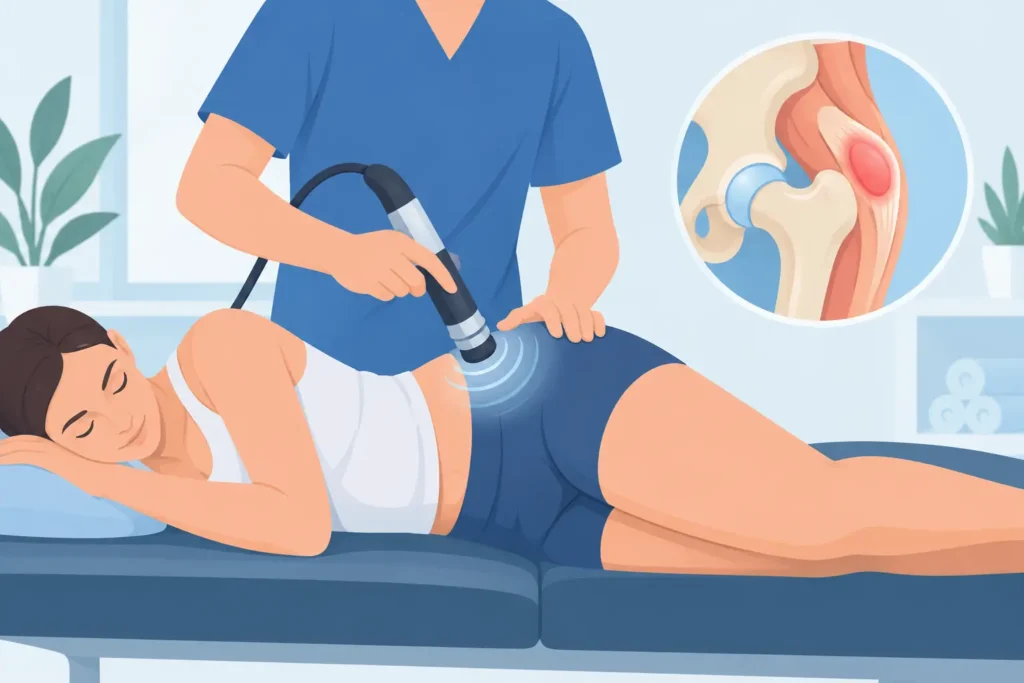
That sharp ache on the outside of your hip can make ordinary moments feel like obstacles. Rolling onto the painful side in bed, getting out of the car, climbing stairs, or taking a longer walk may all trigger it. If rest, stretching, or medication has not provided enough relief, you may be asking: can shockwave treat hip bursitis?
For some patients, shockwave therapy can be a useful non-surgical part of treatment for persistent outer hip pain. It is not a one-size-fits-all cure, and the right approach depends on what is actually causing your symptoms. A careful evaluation matters because what many people call hip bursitis is often related to irritated gluteal tendons, not the bursa alone.
What hip bursitis pain often means
Hip bursitis usually refers to inflammation or irritation of the greater trochanteric bursa, a small fluid-filled sac near the bony point on the outside of the hip. Bursae reduce friction between muscles, tendons, and bone. When that area becomes sensitive, pressure and movement can become painful.
However, clinicians now often use the broader term greater trochanteric pain syndrome, or GTPS. This label recognizes that pain at the outside of the hip can involve the bursa, the gluteus medius or gluteus minimus tendons, muscle weakness, altered walking mechanics, lower-back issues, or a combination of these factors.
This distinction affects treatment. If a tendon is overloaded or weakened, simply trying to calm inflammation may not address the full problem. The most effective recovery plan often combines pain-relieving treatment with gradual strengthening and changes that reduce repeated irritation.
Common signs of outer hip pain include tenderness when pressing the side of the hip, pain when lying on that side, discomfort after walking or standing, and pain when climbing stairs or rising from a chair. Pain that travels below the knee, groin pain, fever, marked swelling, unexplained weight loss, or an inability to bear weight deserves prompt medical evaluation because it may point to a different condition.
Can shockwave treat hip bursitis?
Shockwave therapy may help reduce pain and improve function in people with chronic greater trochanteric pain, particularly when tendon irritation is part of the picture. The treatment delivers acoustic pressure waves into targeted tissue. These waves are not electric shocks, and they do not involve surgery or injections.
In a clinical setting, shockwave therapy is intended to stimulate the body’s healing response in painful, slow-to-recover tissue. Depending on the device and treatment protocol, it may encourage circulation, influence pain signaling, and support tissue remodeling. Patients commonly pursue it when they want an option that may reduce their reliance on pain medication while they work on the underlying movement and strength issues.
Research on shockwave for GTPS is promising, especially for longer-lasting symptoms that have not responded well to basic care. Still, outcomes vary. Some people notice a meaningful change after a few sessions, while others improve more gradually when shockwave is paired with a targeted rehabilitation program. It is better viewed as one tool in a personalized plan than as a stand-alone fix.
Why the type of pain matters
A diagnosis of “bursitis” does not automatically mean shockwave is appropriate. Acute pain after a fall, a fracture, a significant tendon tear, hip arthritis, nerve-related pain from the spine, or a joint problem may require a different plan. A clinician should identify the source of pain through your history, movement assessment, and, when necessary, imaging or referral.
Shockwave tends to make the most sense when pain has become persistent and conservative measures have not restored normal activity. It can be especially relevant for people who have been avoiding walks, workouts, sleep positions, or work tasks because the outside of the hip remains tender.
What a shockwave appointment is like
Treatment starts with locating the most relevant painful tissue, rather than simply treating every sore area. Gel is applied to the skin, and the treatment head is moved over the target area. Each session is typically brief.
You may feel tapping, pressure, or a deep ache during treatment. The intensity can be adjusted to keep the experience tolerable. Mild soreness afterward is possible, similar to how an irritated area may feel after a workout or hands-on treatment. This usually settles within a short period, but your provider should explain what is normal for your specific plan.
Many protocols involve a series of appointments spaced over several weeks. The exact number varies based on symptom duration, tissue involvement, activity demands, and your response. Improvement is often measured by practical changes: sleeping with less discomfort, walking farther, climbing stairs more confidently, or returning to exercise with fewer flare-ups.
The treatment works better with the right recovery plan
A painful hip often creates a cycle. You avoid loading the leg because it hurts, the supporting muscles become less effective, and the hip becomes more sensitive during everyday movement. Breaking that cycle usually requires more than passive treatment.
Your plan may include modified activity, targeted exercises for the hip and core, and guidance on sleep and walking mechanics. For example, avoiding prolonged pressure directly on the painful side can reduce nighttime irritation. A pillow between the knees may help some side sleepers keep the hip in a more comfortable position. Temporarily reducing hills, long walks, or high-impact activity can also give irritated tissue room to settle without requiring complete inactivity.
Strengthening should be gradual. Aggressively stretching or pushing through sharp outer-hip pain can aggravate symptoms in some cases, particularly when gluteal tendons are involved. The goal is to rebuild the hip’s ability to handle load, not to force a quick return to activity.
At Acupuncture & Injury, shockwave therapy may be considered alongside other non-surgical, drug-reducing options such as acupuncture and individualized injury care. The appropriate combination depends on your examination, health history, and recovery goals.
Who should avoid or postpone shockwave therapy?
Shockwave therapy is not right for everyone. A provider should review your medical history before treatment, including pregnancy, bleeding disorders, blood-thinning medication, cancer near the proposed treatment area, active infection, reduced sensation, and the presence of an implanted device. It may also need to be postponed when there is concern for a fracture or other urgent injury.
Do not assume that increasing pain is simply bursitis. Seek timely care after a major injury, if the hip is hot or visibly swollen, if you have fever or feel ill, or if pain is severe enough that you cannot safely walk. Those symptoms need proper assessment before any therapy is started.
When to consider an evaluation
If outer hip pain has lasted more than a few weeks, keeps waking you at night, or repeatedly returns when you resume normal activity, an evaluation can help clarify the next step. This is particularly valuable if you have tried rest, over-the-counter medication, or generic exercises without lasting improvement.
A good treatment plan should give you clear expectations. You should know what tissue is likely involved, why shockwave is or is not being recommended, what other care should accompany it, and how progress will be measured. Patients seeking relief without leaning on long-term pain medication deserve that level of clarity.
Hip pain can make your world smaller one avoided stairway, one missed walk, one sleepless night at a time. With an accurate diagnosis and a plan that addresses both pain and movement, shockwave therapy may be a practical step toward getting those everyday activities back.
Leave a reply